MyVibePet
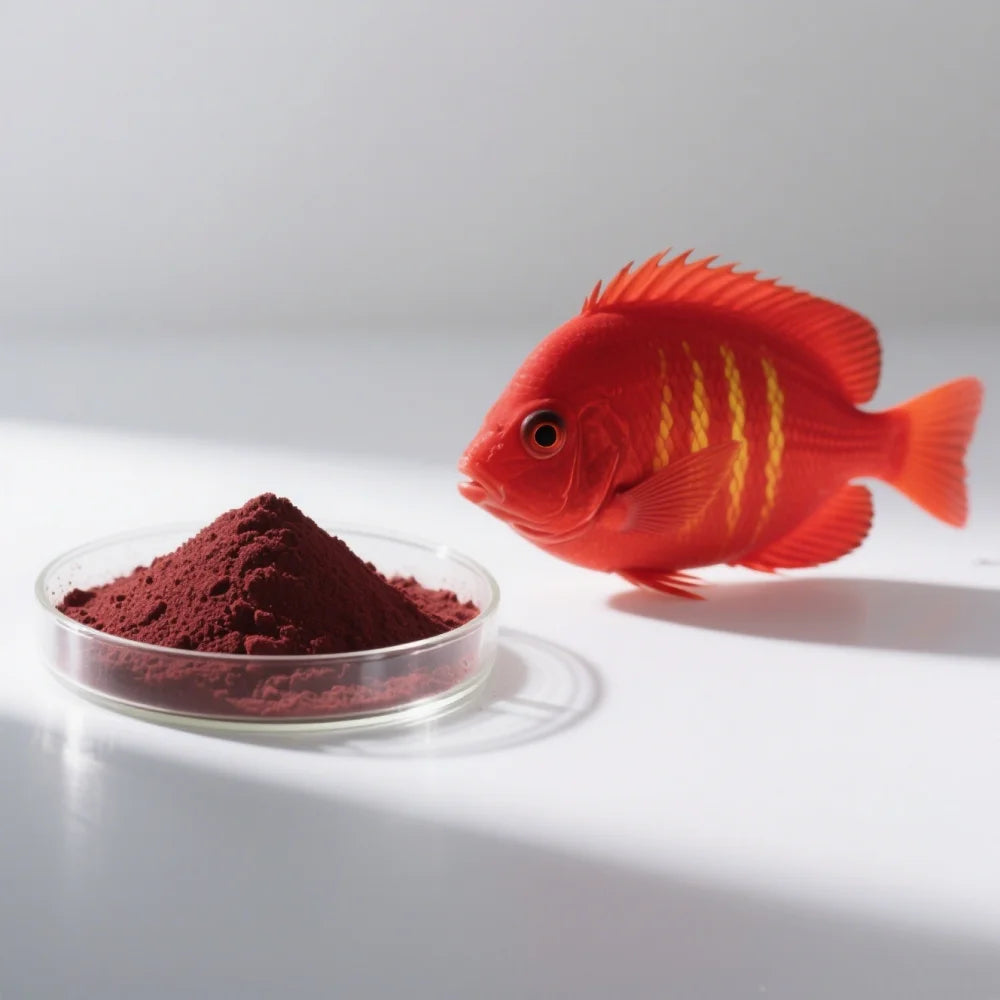
LOLO Material Astaxanthin Natural Astaxanthin Haematoc Fish Feed Fish Food Astaxanthin
LOLO Material Astaxanthin Natural Astaxanthin Haematoc Fish Feed Fish Food Astaxanthin
Couldn't load pickup availability
SPECIFICATIONS
Battery Included: No
Brand Name: NONE
High-concerned chemical: None
LCD Display: Yes,Yes
Material: Plastic,Plastic
Max Output: 100g,100g
Min Output: 50g,50g
Model Number: FM026,FM026
Number of gears: 1,1
Origin: Mainland China,Mainland China
Product Name: Astaxanthin powder for fish
Voltage: 220-240V,220-240V
Volume: 50g,200g
Product Description
Product Name: Astaxanthin
Latin name: Haematococcus pluvialis
Source: Haematococcus pluvialis
Appearance: Dark red powder
Active ingredient: Astaxanthin
Astaxanthin (pronounced as-tuh-zan'-thin) is a carotenoid. It belongs to a larger class of phytochemicals known as terpenes. It is classified as a xanthophyll, which means "yellow leaves". Like many carotenoids, it is a colorful, lipid-soluble pigment. Astaxanthin is produced by microalgae, yeast, salmon, trout, krill, shrimp, crayfish, crustaceans, and the feathers of some birds. While astaxanthin is a natural nutritional component, it can be found as a food supplement. The supplement is intended for human, animal, and aquaculture consumption. The commercial production of astaxanthin comes from both natural and synthetic sources. The U.S. Food and Drug Administration (FDA) approved astaxanthin (See: Regulations below) as a food coloring (or color additive) for specific uses in animal and fish foods. The European Union (actually European Commission) considers it food dye within the E number system, E161. In 1948, Nobel prizewinner George Wald surmized, "This could lead to an important new use of astaxanthin as a drug delivery for medicines that are insoluble in water, and give designers of new food colourants or dyestuffs an interesting new capability." Astaxanthin is used as a feed supplement for salmon, crabs, shrimp, chickens and egg production. Regardless of the source, astaxanthin provides some important benefits beyond coloration. It also has been found to be essential for proper growth and survival.

Astaxanthin Function
1. Powerful antioxidant effects.
2. Increase strength and endurance
3. Boosts Immune System
4. Inhibit Skin aging with skin-whitening effect. Prevent Diabetic Syndrome & Arteriosclerosis
6. Cardiovascular & heart health Benefits
7. Improve Eye Health.
8. Anticancer, Anti-inflammatory & Anti-helicobacter Pylori Activity
9. Nervous System Benefits

Astaxanthin Application
For seafood and animals:
The primary use of synthetic astaxanthin today is as an animal feed additive to impart coloration, this includes farm-raised salmon and egg yolks. In that, synthetic carotenoid (i.e., coloured yellow, red or orange) pigments represent about 15-25% of the cost of production of commercial salmon feed. Today, essentially all commercial astaxanthin for aquaculture is produced synthetically from petrochemical sources, with an annual turnover of over $200 million, and a selling price of ~$2000 per kilo of pure astaxanthin.
For humans:
Currently, the primary use for humans is as a food supplement. Research shows that due to astaxanthin's potent antioxidant activity, it may be beneficial in cardiovascular, immune, inflammatory and neurodegenerative diseases.Some sources have demonstrated its potential as an anti-cancer agent. Research supports the assumption that it protects body tissues from oxidative damage.It also crosses the blood-brain barrier, which makes it available to the eye, brain and central nervous system to alleviate oxidative stress that contributes to ocular, and neurodegenerative diseases such as glaucoma.


Product Description
Product Name: Astaxanthin
Latin name: Haematococcus pluvialis
Source: Haematococcus pluvialis
Appearance: Dark red powder
Active ingredient: Astaxanthin
Astaxanthin (pronounced as-tuh-zan'-thin) is a carotenoid. It belongs to a larger class of phytochemicals known as terpenes. It is classified as a xanthophyll, which means "yellow leaves". Like many carotenoids, it is a colorful, lipid-soluble pigment. Astaxanthin is produced by microalgae, yeast, salmon, trout, krill, shrimp, crayfish, crustaceans, and the feathers of some birds. While astaxanthin is a natural nutritional component, it can be found as a food supplement. The supplement is intended for human, animal, and aquaculture consumption. The commercial production of astaxanthin comes from both natural and synthetic sources. The U.S. Food and Drug Administration (FDA) approved astaxanthin (See: Regulations below) as a food coloring (or color additive) for specific uses in animal and fish foods. The European Union (actually European Commission) considers it food dye within the E number system, E161. In 1948, Nobel prizewinner George Wald surmized, "This could lead to an important new use of astaxanthin as a drug delivery for medicines that are insoluble in water, and give designers of new food colourants or dyestuffs an interesting new capability." Astaxanthin is used as a feed supplement for salmon, crabs, shrimp, chickens and egg production. Regardless of the source, astaxanthin provides some important benefits beyond coloration. It also has been found to be essential for proper growth and survival.
Astaxanthin Function
1. Powerful antioxidant effects.
2. Increase strength and endurance
3. Boosts Immune System
4. Inhibit Skin aging with skin-whitening effect. Prevent Diabetic Syndrome & Arteriosclerosis
6. Cardiovascular & heart health Benefits
7. Improve Eye Health.
8. Anticancer, Anti-inflammatory & Anti-helicobacter Pylori Activity
9. Nervous System Benefits
Astaxanthin Application
For seafood and animals:
The primary use of synthetic astaxanthin today is as an animal feed additive to impart coloration, this includes farm-raised salmon and egg yolks. In that, synthetic carotenoid (i.e., coloured yellow, red or orange) pigments represent about 15-25% of the cost of production of commercial salmon feed. Today, essentially all commercial astaxanthin for aquaculture is produced synthetically from petrochemical sources, with an annual turnover of over $200 million, and a selling price of ~$2000 per kilo of pure astaxanthin.
For humans:
Currently, the primary use for humans is as a food supplement. Research shows that due to astaxanthin's potent antioxidant activity, it may be beneficial in cardiovascular, immune, inflammatory and neurodegenerative diseases.Some sources have demonstrated its potential as an anti-cancer agent. Research supports the assumption that it protects body tissues from oxidative damage.It also crosses the blood-brain barrier, which makes it available to the eye, brain and central nervous system to alleviate oxidative stress that contributes to ocular, and neurodegenerative diseases such as glaucoma.